
Poker hand rankings – complete guide with examples
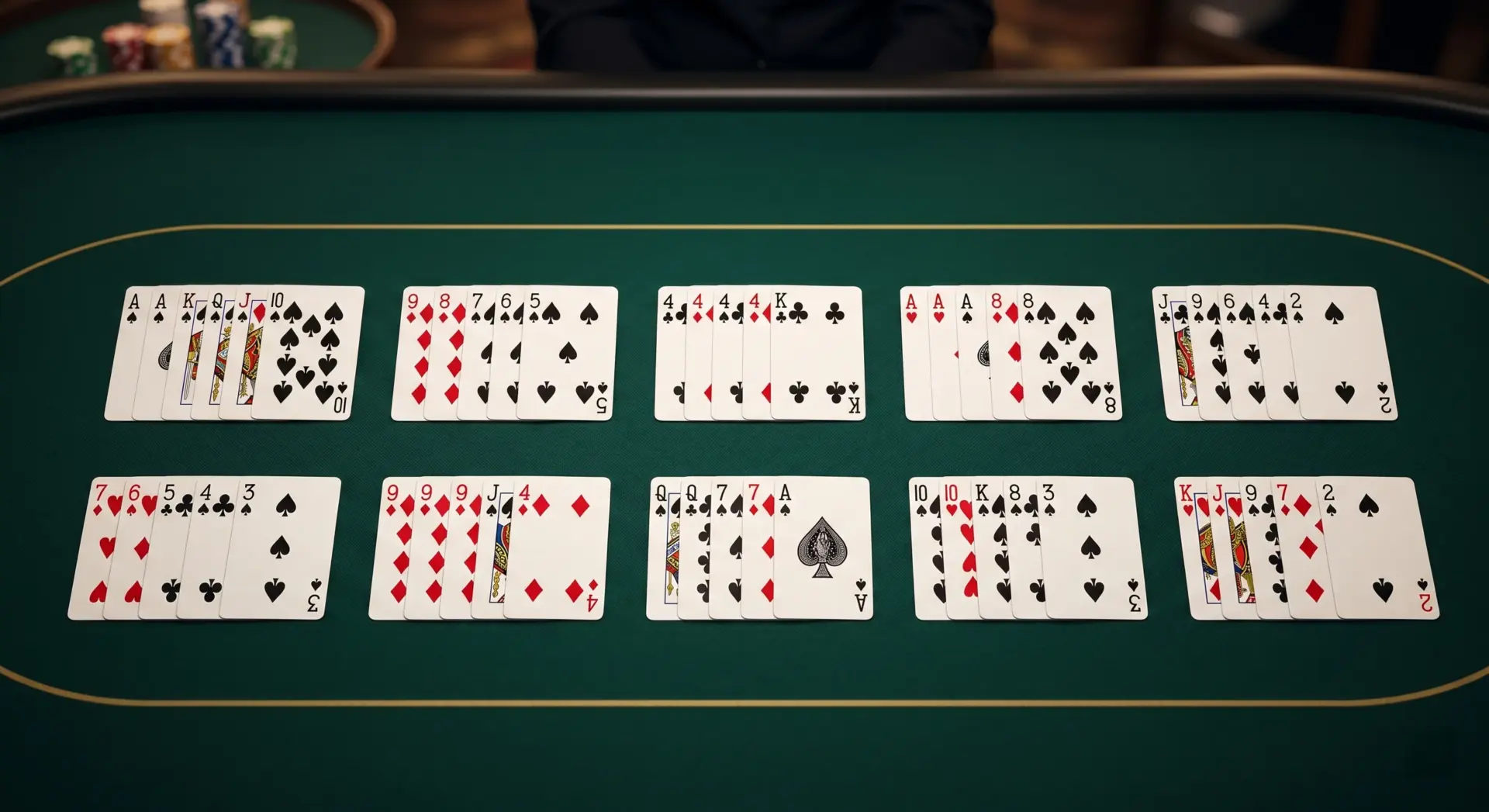
Knowing which hand beats which is the single most important thing to learn before sitting at a poker table. Get this wrong and every other decision becomes irrelevant. There are 10 possible hand categories in standard poker, ranked from the strongest to the weakest. This guide covers all 10, with examples, probability, and the practical situations where each hand tends to appear.
All rankings apply to Texas Hold’em – the format used in both the main poker room and Legion Poker on 1xBet.
The 10 poker hand rankings – quick reference
| Rank | Hand | Example | Probability* |
|---|---|---|---|
| 1 | Royal Flush | A K Q J 10 (same suit) | 0.000154% |
| 2 | Straight Flush | 7 8 9 10 J (same suit) | 0.00139% |
| 3 | Four of a Kind | K K K K 3 | 0.0240% |
| 4 | Full House | Q Q Q 7 7 | 0.1441% |
| 5 | Flush | A J 8 5 2 (same suit) | 0.1965% |
| 6 | Straight | 5 6 7 8 9 (mixed suits) | 0.3925% |
| 7 | Three of a Kind | 9 9 9 K 2 | 2.1128% |
| 8 | Two Pair | J J 4 4 A | 4.7539% |
| 9 | One Pair | 10 10 7 3 Q | 42.2569% |
| 10 | High Card | A K 9 6 2 (no combination) | 50.1177% |
*Probability of being dealt each hand type in a five-card draw from a 52-card deck.
The most important practical takeaway from the probability column: the majority of five-card poker hands contain either one pair or no combination at all. Royal flushes and straight flushes are mathematically rare – most players go hundreds of sessions without seeing one.
1. Royal Flush
The strongest possible hand in poker. An ace-high straight flush – the five highest cards of any one suit in sequence.
Example: A♠ K♠ Q♠ J♠ 10♠
A royal flush cannot be beaten or tied by any other hand. If two players somehow each held a royal flush (impossible in a standard game with one deck), it would result in a split pot – but this scenario cannot occur with 52 cards.
In Texas Hold’em, a royal flush requires five of the seven available cards (two hole cards plus five community cards) to all be the same suit and form the sequence 10-J-Q-K-A. The odds of flopping a royal flush with suited hole cards such as A-K suited are roughly 1 in 19,600.
2. Straight Flush
Five consecutive cards of the same suit. The highest card in the sequence determines the rank of the straight flush when two players hold one.
Example: 7♥ 8♥ 9♥ 10♥ J♥ (jack-high straight flush)
A straight flush beats every hand except a higher straight flush or a royal flush. In practice, if the board shows three cards of the same suit in sequence, most experienced players immediately consider whether an opponent could hold a straight flush before betting heavily.
The lowest possible straight flush is A-2-3-4-5 of the same suit (called a “steel wheel”), where the ace plays as a low card.
3. Four of a Kind
All four cards of the same rank, plus any fifth card (called the kicker).
Example: K♠ K♥ K♦ K♣ 3♠
When two players hold four of a kind (possible in Texas Hold’em if the community cards contain a pair), the player with the higher four of a kind wins. Four aces beats four kings. If both players hold the same four of a kind (four community cards of the same rank), the fifth card – the kicker – decides the winner.
Four of a kind is informally called “quads.” At the micro-stakes tables on 1xBet, quads tend to be bet aggressively by newer players and more subtly by experienced ones who want to extract maximum value.
4. Full House
Three cards of one rank combined with two cards of another rank.
Example: Q♠ Q♥ Q♦ 7♣ 7♥ (queens full of sevens)
The three-of-a-kind portion determines the rank of the full house first. Q-Q-Q-7-7 beats J-J-J-A-A because three queens outrank three jacks, regardless of the pair. If two players have the same three-of-a-kind rank (using community cards), the pair portion decides the winner.
Full houses are often described in shorthand: “queens full of sevens” or “queens full.” In Texas Hold’em, a full house commonly forms when the board pairs – a player holding a pair in their hole cards who hits a matching card on the board, or a player holding a set (three of a kind) who sees a paired board card.
5. Flush
Five cards of the same suit, not in sequence.
Example: A♣ J♣ 8♣ 5♣ 2♣ (ace-high flush)
When two players hold a flush, the player with the highest card in their flush wins. An ace-high flush beats a king-high flush. If the highest cards tie, the second-highest card is compared, and so on down the line.
In Texas Hold’em, a flush requires at least three cards of the same suit on the board. With two suited hole cards, a player has roughly a 35% chance of completing a flush by the river when two cards of their suit appear on the flop. This is called a flush draw, and understanding whether to chase it requires knowledge of pot odds – covered in the poker odds guide.
6. Straight
Five consecutive cards of mixed suits.
Example: 5♠ 6♥ 7♦ 8♣ 9♥ (nine-high straight)
The highest card in the straight determines its rank. An ace can play as either the highest card (A-K-Q-J-10, a Broadway straight) or the lowest card (A-2-3-4-5, a wheel). An ace cannot wrap around – K-A-2-3-4 is not a valid straight.
When two straights are compared, the one with the higher top card wins. A 9-high straight beats an 8-high straight. If both players have the same straight (entirely possible using community cards), the pot is split.
The most common beginner mistake with straights is misreading a wheel. Holding A-2 on a 3-4-5 board completes the lowest possible straight – it’s still a straight and beats any two pair or three of a kind, but loses to a higher straight if the board develops.
7. Three of a Kind
Three cards of the same rank, plus two unrelated cards.
Example: 9♠ 9♥ 9♦ K♣ 2♠
In Texas Hold’em, three of a kind comes in two forms with different names:
Set: A player uses a pocket pair (two hole cards of the same rank) plus one matching community card. Example: holding 9-9 in hand, with a 9 appearing on the board.
Trips: A player uses one hole card plus two matching community cards. Example: holding K-9 with 9-9 appearing on the board.
Both are three of a kind and rank the same. However, sets are significantly more valuable strategically because they are harder for opponents to detect – the matching cards are hidden in the player’s hand rather than visible on the board.
When two players hold three of a kind with the same rank (using two community cards of that rank), the kicker cards determine the winner.
8. Two Pair
Two separate pairs of cards, plus one unrelated card.
Example: J♠ J♥ 4♦ 4♣ A♠
The higher pair is compared first. J-J-4-4-A beats 10-10-9-9-K because jacks outrank tens. If the top pairs are equal, the lower pair is compared. If both pairs are equal, the kicker decides.
Two pair is the most common winning hand at a typical Texas Hold’em table. In a multi-player pot, a single pair is often beaten, but a strong two pair – especially top two pair (using both hole cards to pair the top two community cards) – is frequently the best hand at showdown.
9. One Pair
Two cards of the same rank, plus three unrelated cards.
Example: 10♠ 10♥ 7♣ 3♦ Q♠
When comparing pairs, the higher pair wins. A pair of aces beats a pair of kings. If two players hold the same pair, the kicker cards are compared in order from highest to lowest until a difference is found.
One pair accounts for over 40% of all possible five-card hands. At a full table of nine players in Texas Hold’em, a single pair is rarely the best hand by the river – but in heads-up play (two players), one pair wins a significant portion of pots.
10. High Card
No combination – five unrelated cards that don’t form any of the above hands.
Example: A♠ K♥ 9♦ 6♣ 2♠ (ace-high)
The hand is described by its highest card. Ace-high beats king-high. If the highest cards tie, the second-highest is compared, continuing down through all five cards.
High card is technically the weakest possible hand, but it wins plenty of pots through bluffing or when the board is so unfavourable that neither player connects with it. In no-limit Texas Hold’em, a player holding high card can still win by betting and forcing all opponents to fold – the hand only needs to go to showdown if a player calls.
How kickers work
A kicker is the card (or cards) used to break ties when two players hold the same hand rank.
Example: Player A holds A-K. Player B holds A-Q. The board shows A-7-5-3-2.
Both players have one pair (aces). The kicker is the next highest card: K for Player A, Q for Player B. Player A wins because king outranks queen.
Kickers matter most with pairs and two pairs. With three of a kind, the highest remaining cards are compared. With full houses and four of a kind, the primary rank (the three-of-a-kind or four-of-a-kind portion) usually decides before kickers become relevant.
One of the most common beginner mistakes is losing to a better kicker without realising it – playing A-5 on an ace-high board and losing to an opponent with A-K, for instance.
Reading the board in Texas Hold’em
In Texas Hold’em, the five community cards are shared. This means a player’s actual hand must be constructed from a combination of their two hole cards and those five board cards – using any combination to make the best five.
A few scenarios that trip up beginners:
Playing the board: If the five community cards already make a straight or flush that beats anything a player’s hole cards add, the player is “playing the board.” Example: the board shows A-K-Q-J-10 (a royal flush in mixed suits, not a true royal flush), and a player holds 2-3. Their best five-card hand is whatever five community cards work best – but so is every other player’s. The pot splits among all remaining players.
Counterfeiting: A player holds 7-8 and the board shows 7-8-A-A-K at showdown. Their hole cards (7-8) are now beaten by the board pair of aces. Their best hand is A-A-K-8-7, but an opponent holding any card higher than 8 would split or win with a better kicker. The pair of sevens the player made early in the hand was “counterfeited” by the aces appearing on the board.
Practical tips for remembering hand rankings
The order from strongest to weakest follows a logical pattern based on rarity. The harder a hand is to make, the stronger it is.
A useful memory device for the top five hands: R-S-F-F-F – Royal, Straight flush, Four of a kind, Full house, Flush. Below that, Straight, Three of a kind, Two pair, One pair, High card.
At the lowest-stakes tables on 1xBet ($0.01/$0.02 cash games), most pots are won by one pair, two pair, or three of a kind. Royal flushes and straight flushes are genuinely rare events. Adjusting expectations to the realistic distribution of hands – rather than playing for the best possible hand every time – is one of the first mental shifts that separates improving players from stagnant ones.
Getting started on 1xBet
Once hand rankings are clear, the next step is sitting at a table. The 1xBet poker section offers daily freerolls in Legion Poker with no entry fee – a risk-free environment to practice reading the board and identifying hand strengths in real time. Cash game tables start at $0.01/$0.02 blinds, accessible after a ₹300 minimum deposit via UPI or Paytm.
The full poker lobby is available through the 1xBet app on Android and iOS.
Frequently asked questions
What is the highest hand in poker?
The royal flush – ace, king, queen, jack, and ten of the same suit. It cannot be beaten by any other hand.
Does a straight beat a flush in poker?
No. A flush (five cards of the same suit) beats a straight (five consecutive cards of mixed suits). The ranking from strongest to weakest is: straight flush, four of a kind, full house, flush, straight.
What beats a full house in poker?
Four of a kind, a straight flush, and a royal flush all beat a full house. A full house beats a flush, straight, three of a kind, two pair, one pair, and high card.
Can an ace be used as a low card in a straight?
Yes. An ace can play as the lowest card in a wheel straight: A-2-3-4-5. It cannot wrap around – K-A-2-3-4 is not a valid straight.
What happens when two players have the same hand?
The pot is split equally. If kicker cards differ, the player with the higher kicker wins rather than splitting. If all five cards are identical in rank, the pot splits regardless of suit.
What is the most common winning hand in Texas Hold’em?
One pair and two pair are the most common winning hands at showdown, particularly at full tables. The exact distribution depends on the number of players and whether the hand goes to the river.
Summary
The 10 hand rankings run from royal flush (rarest, strongest) down to high card (most common, weakest). In real Texas Hold’em sessions, the vast majority of hands are decided by one pair, two pair, or three of a kind. Understanding hand rankings is the foundation – the next layer is understanding how likely each hand is to win in a given situation, which requires learning pot odds and equity. That is covered in the poker odds guide.

